

CENIEH participates in this international study, which examined 42 European sites to reconstruct how technological changes emerged and spread during the Middle Pleistocene, leading to the development of the Levallois method
The Centro Nacional de Investigación sobre la Evolución Humana (CENIEH) participates in a study recently published in the journal Quaternary Science Advances that examines how technological traditions evolved in Western Europe around 400,000 years ago. The results indicate that key Middle Palaeolithic innovations, such as the Levallois method, did not emerge abruptly at the onset of Marine Isotope Stage 11 (MIS 11), but instead have earlier roots and diversified within a context of favourable climatic conditions.
This study, the result of a major international collaboration carried out within the NEANDROOTS project funded by the Agence Nationale de la Recherche (ANR), explores technological innovations and cultural diversity in Western Europe around the MIS 11 threshold (ca. 424–374 ka). This period represents a crucial stage in the transition from the Lower to the Middle Palaeolithic and coincides with the emergence of Neanderthal features in the European fossil record. Following the severe glacial episode of MIS 12, the long interglacial of MIS 11 likely promoted human expansion, more intensive occupation of territories, and the diffusion of new technological behaviours.
Overall, the study argues that the technological innovations documented during this period reflect a gradual process of cultural evolution based on the inheritance and diversification of pre-existing traditions, rather than abrupt cultural breaks or population replacement events. Under more temperate and stable climatic conditions, Middle Pleistocene populations expanded their geographic range, maintained contacts across regions, and developed increasingly complex technological systems.
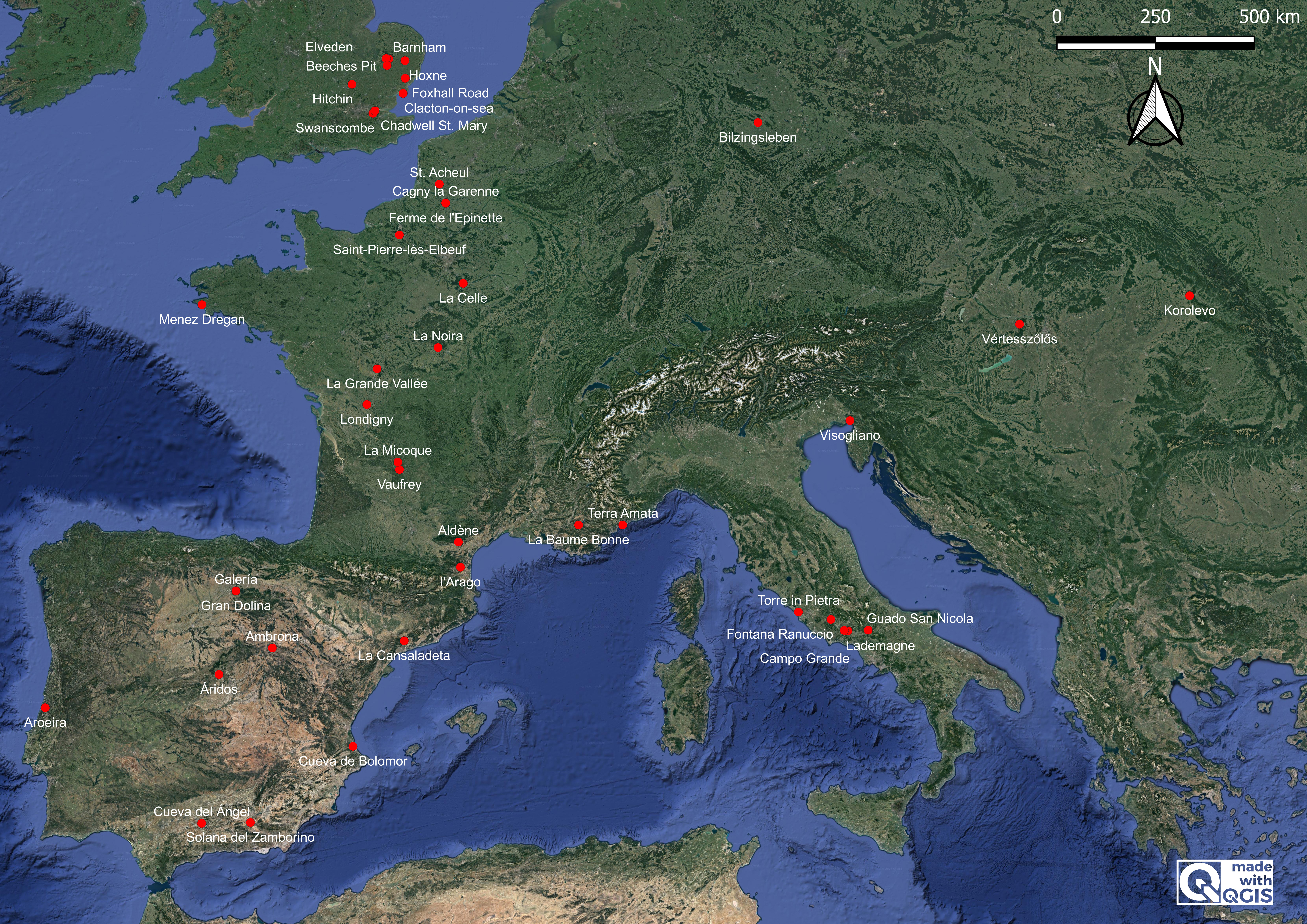
42 European sites
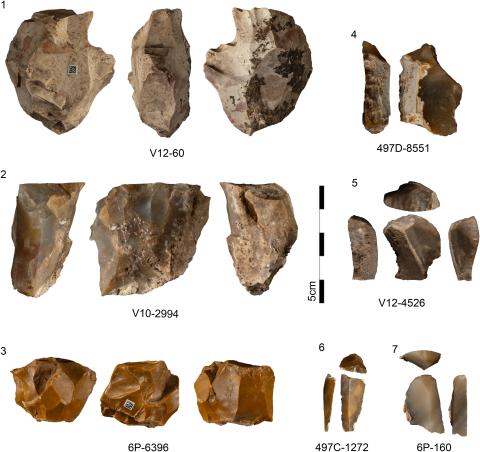
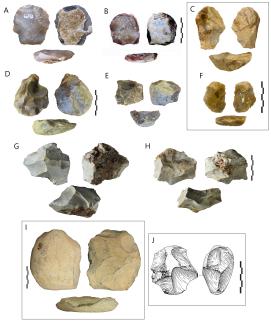
The authors analysed 47 archaeological levels from 42 European sites, ranging from France and Italy to the Iberian Peninsula and Great Britain, including several cases from Central and Eastern Europe. The research focuses on lithic technology, particularly core reduction strategies—including the development and diversification of the Levallois method—Large Cutting Tools (LCTs) such as handaxes and cleavers, and retouched tools.
To compare these assemblages, the team applied a cladistic approach (three-item analysis, 3IA), treating each lithic assemblage as a cultural taxonomic unit. Cladistic analysis, widely used in evolutionary biology, reconstructs relationships based on shared derived innovations. In this case, the method makes it possible to evaluate the hierarchical organisation of technological traits, identify shared innovations, and assess how core technologies and tool production systems evolved over time.
The results reveal a structured hierarchical pattern among European assemblages, including a clear distinction between predominantly British and continental groups. However, within Western Europe there is no evidence of strong regional cultural endemism. Rather than strictly isolated technological traditions, the analysis identifies technological connections between northern and southern European sites. This pattern suggests recurrent contacts and interaction between populations, facilitated by the expansion of habitable areas during MIS 11.
One of the most significant findings is that Levallois core technology likely predates MIS 12, survived the subsequent glacial episode, and diversified during MIS 11 instead of representing a wholly new innovation of that period. The study also documents an intensification of complex core reduction systems, including hierarchical centripetal and discoidal methods, which coexisted with Acheulean traditions characterised by the production of LCTs.
CENIEH’s participation in this research reinforces its role in the study of technological and cultural processes during the European Middle Pleistocene and in the application of innovative analytical approaches to understanding human evolution..