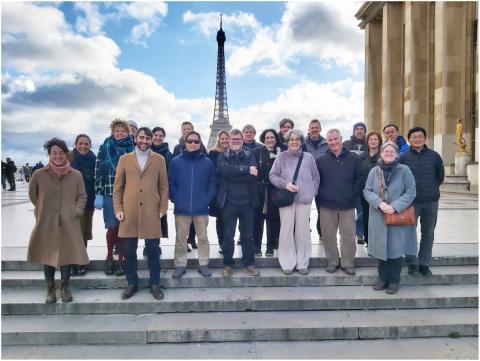


This technician from the CENIEH's Luminescence Laboratory defended her doctoral thesis on the evolution of rivers and the landscape during the Quaternary in the eastern Cantabrian margin

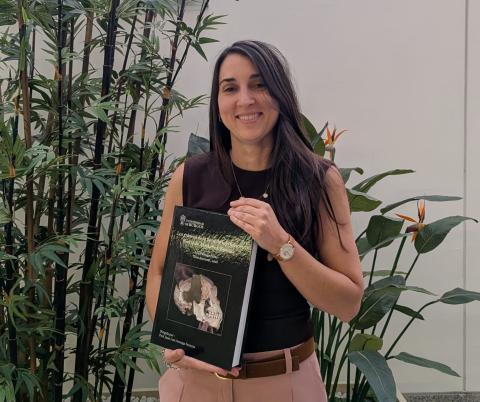
Miren del Val Blanco, a technician at the Luminescence Laboratory at the Centro Nacional de Investigación sobre la Evolución Humana (CENIEH), defended this morning at the University of the Basque Country (EHU) her thesis entitled “Quaternary Fluvial Evolution of the Eastern Cantabrian Valleys (North of Spain),” supervised by Arantza Aranburu, from EHU, and Eneko Iriarte, from the University of Burgos (UBU).
This doctoral thesis provides new insights into the evolution of basins and the landscape during the Quaternary in the eastern Cantabrian margin. The work reconstructs the recent geological history of these river valleys in an especially complex and dynamic environment, combining advanced terrain analysis techniques with geochronological methods, using a regional approach.
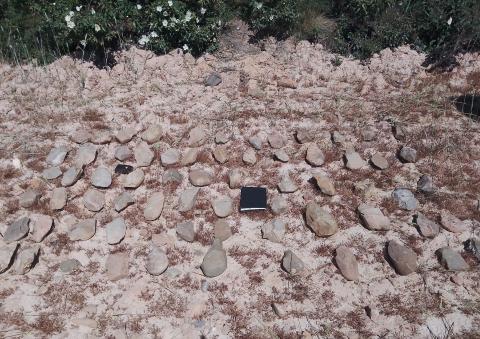
To this end, she used digital terrain models obtained through LiDAR technology and Geographic Information Systems (GIS), which allow the identification and mapping of ancient river terraces, even in areas heavily altered by vegetation, urbanization, or slope processes. She also applied dating techniques such as optically stimulated luminescence (OSL) and electron paramagnetic resonance (ESR) to establish the age of these deposits.
“Despite significant challenges, such as the poor preservation of the terraces and the complexity of the dating signals, the results have allowed me to define a common architecture for the river valleys and to identify up to nine recurrent terrace levels across the studied basins. The data obtained indicate that the lowest terraces (from 10 to 25 m) were formed during the Middle Pleistocene, between 140,000 and 400,000 years ago," explains Miren del Val.
Overall, the research shows that the valleys studied share a similar geological evolution, conditioned by regional factors such as climatic changes and tectonic activity. These results contribute to a better understanding of how the river landscapes of the north of the Iberian Peninsula have evolved over hundreds of thousands of years.
The examination committee, chaired by Iñaki Antigüedad (EHU) and composed of Melanie Kranz-Bartz (Ruhr-Universität Bochum) and Miguel Bartolomé (CSIC), awarded the new doctor from the University of the Basque Country (EHU) the unanimous grade of outstanding.