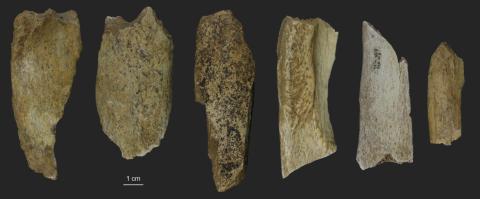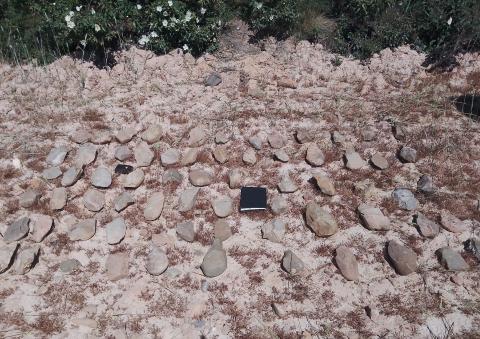


CENIEH and ITCL have launched a collaboration to carry out pioneering hyperspectral analyses at levels TD3 and TD4 of this archaeopalaeontological site in the Sierra de Atapuerca, with the aim of studying their infrared response and gaining new insights into the earliest stages of the site’s formation through non-destructive techniques and sensors capable of capturing information beyond the range of human vision
The Centro Nacional de Investigación sobre la Evolución Humana (CENIEH) and the Instituto Tecnológico de Castilla y León (ITCL) have begun a collaboration to advance the application of hyperspectral analysis in the study of archaeopalaeontological sites. As part of this initiative — aimed at strengthening links with the private and industrial sectors in order to foster technical innovation and knowledge transfer — researchers have studied the infrared response of the oldest levels of the Gran Dolina Site in the Sierra de Atapuerca (Burgos, Spain).
These are levels TD3 and TD4, which began to form around one million years ago, when groundwater receded from the cave and sediments from the slopes of the Sierra de Atapuerca began to accumulate within it. This marked a major shift in the site’s sedimentary processes and, at the same time, the beginning of the accumulation of animal fossils and stone tools.
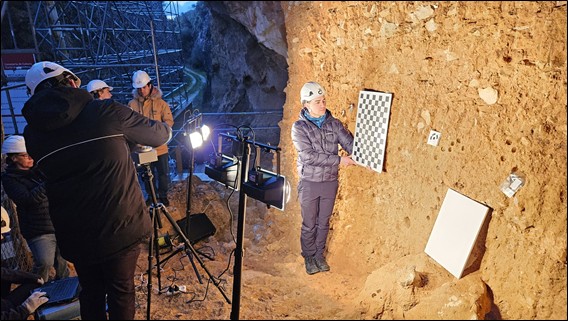
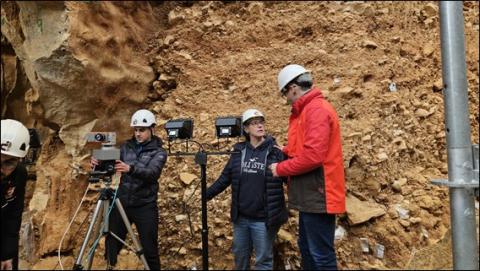
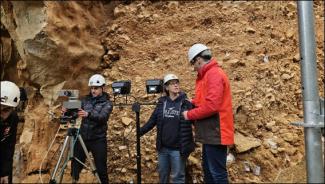
The initial fieldwork involved collecting data under daylight conditions, at night, and under controlled artificial lighting, in order to analyse how sediments and fossils respond to different lighting conditions.
“We used a hyperspectral camera operating in the visible and near-infrared range, extending detection capabilities beyond what can be perceived by the human eye,” explains CENIEH geologist Alfonso Benito Calvo.
Hyperspectral analysis
Hyperspectral analysis combines different sensors and statistical methods to study the electromagnetic spectrum of light reflected by different materials, enabling detailed analysis of their composition and properties.
Hyperspectral cameras record reflected light information at every point on the analysed surface, generating images with a high level of both spatial and spectral detail by capturing data across a broad range of wavelengths for each point.
“This type of technology could make it possible to identify differences in the composition of materials present at archaeological sites, such as sediments or fossil remains, based on their characteristic spectral signatures,” says Julen Rostan, head of the Intelligent Artificial Perception Systems research group at ITCL Centro Tecnológico.
The data obtained are subsequently processed using statistical techniques and analytical algorithms that support the classification and differentiation of the various elements, as well as the generation of compositional maps of the site. By extending hyperspectral analysis beyond the visible range, the researchers aim to improve the compositional characterisation of these sediments and enable the automatic documentation of the archaeopalaeontological record using non-destructive methods.
The combination of hyperspectral cameras capable of capturing the visible spectrum in hundreds of bands and, for the first time, sensors able to record the infrared spectrum beyond the range of human vision could provide unprecedented information — previously invisible — about the earliest stages in the formation of the Gran Dolina Site.